Showing posts with label Nola. Show all posts

Saturday, March 24, 2012

Nonna Mia. 3125 Esplanade Avenue, New Orleans, LA.

Saint Expedite.  Patron of prompt delivery.
La dolce vita is saucy in New Orleans.  New Orleans is not a pizza town, so when a pizzeria stays in business, you can bet that they cook a good pie.  With indoor and outdoor seating, Nonna Mia does what it does very well.

On Mondays and Tuesdays, pitchers of beer are five dollars, and bottles of wine are half price.  This is reason enough for some visitors to New Orleans to extend their stays past a weekend.  Nonna Mia, like every generation of endeavors, was born out of love.  New Orleans runs on live, shared between grandmother and daughter and granddaughter.  Traditions are made by the people who live them.  Nonna Mia delivers.

Neither deep dish nor thin crust, the pizza chefs at Nonna Mia craft their pies New Orleans-style.  Even if your nonna is not from Nola, you still know good pizza when it is put in front of you.  This is good pizza.  If you walking up to City Park, pop in for a slice at the bar.  If you want to sample a slice of New Orleans pizza culture, you will get an flavorful education.

Thursday, March 22, 2012

Knotty and Nice in New Orleans

A typical New Orleans Street.
Knitting is knotty, but no one is naughty in New Orleans, Louisiana.  If anything is racy, it is happening at the Fair Grounds.  If anything is innocent, it is happening on Ursulines Street.  If anyone is happy...well, that could be anywhere between Hollygrove and Holy Cross.

Saturday, March 10, 2012

A bed and breakfast visit on Esplanade Avenue


A fictionalized account of a typical day on the 2200 block of Esplanade Avenue, New Orleans, Louisiana, U.S.A.  Everything is familiar except the ending.  In New Orleans, nobody asks anybody to stop singing.  Everybody encourages everybody else.  Everybody follows the lead of the muse.


New Orleans is for lovers of the good life.

Monday, February 20, 2012

Ode to New Orleans.

A face made for radio, an outfit made for Mardi Gras.

Walk down a New Orleans street and you will see people tending their own business, which is none of yours, part of an inscrutable communal body and spirit.  Faith, hope, and charity keep New Orleans running, along with talent, gumption, tenacity, mendacity, tradition, and lessons learned from the school of heart knocks.  New Orleans runs on its own fuel, ask anyone who has sniffed the fumes.  You can live the high life in New Orleans, but only after you’ve scraped the bottom.  Not every shooting star burns out.  Some of them land in the Sixth Ward, the Seventh Ward, the Fifth Ward, or the Third Ward in New Orleans, Louisiana.  Where there are bitches, there are riches.  Where there are hens, their eggs are like gold.  

Everyone smiles every day in New Orleans, a city where blessings are counted and curses ignored.  Every street in New Orleans is an Esplanade Avenue.

Monday, February 13, 2012

The Real Esplanade Avenue, New Orleans, LA

Our Lady of Prompt Succor.

When people say they live on the sunny side of Esplanade Avenue, they mean they live on either side.  The side with even-numbered addresses is as chipper and convivial as the odd-sided one.  Esplanade Avenue, running along the panoramic high ground known, locally, as Esplanade Ridge, is the slenderest slice of New Orleans that is a world unto itself.  No street in America is named more truly than Esplanade Avenue in New Orleans, Louisiana.

Unlike Saint Charles Avenue, the street both closest to, and furthest away from, Esplanade Avenue’s sensibility, Esplanade Avenue is a street that is made for walking.  Its length, between City Park and the Old U.S. Mint, is rarely visited by tourists.  If they chose to, they could absorb a few centuries of New Orleaniana in an hour and three quarters.  Esplanade Avenue’s economy is based on neighborhood interaction.  Its story is self-contained, both part and parcel of the whole city in microcosm.
Saint Charles Avenue is a long, run-on variation on a theme, a tinkling on the ivories.  The only people who live on Saint Charles Avenue are the ones who inhabit it.  Esplanade Avenue is a self-contained story told in four acts, starting with picturesque introduction and concluding when there is nothing left to say.  The people who live on Esplanade Avenue love it.  When musicians march on Esplanade Avenue, they play brass and snare.  A perfect street stokes platonic passions that sizzle, under the skin, from one august day to the next.  
Bisected down its neutral ground, the even-sided half of Esplanade Avenue is the Sixth Ward, and the odd side is the Seventh Ward.  The Sixth Ward’s landfill trash, and the household trash meant for recycling, gets picked up at curbside every Monday, Wednesday, and Thursday.  The Seventh Ward puts its trash barrels on the curb every Tuesday, Friday and Saturday.  Esplanade Avenue is very picturesque.  
Between BMC and Check Point Charlie, rhythm and tympanum compliment each other in contrapuntal harmony.  
Fed by the dedicated exit ramp off the Claiborne Avenue Overpass, traffic does not jam on Esplanade Avenue, with its many, patience-inducing traffic lights.  Everyone smiles.  There is plenty of change to spare along a stretch of road that is as old as the city itself, and older, still, in some places.
Between the statue of the Muse of History and the house that Edgar Degas lived in for five months, where Bayou Road, the oldest street in the city, goes from Treme to the Fairgrounds, where the neutral ground narrows at the jag in the lanes after South Galvez Street, bus lines converge and transfer passengers.  Communication and commutation between New Orleans’ distant parts is enhanced and enabled along Esplanade Avenue, where wards converge. 
Different flavors, and different shades, as it traces its patched-pothole track, Esplanade Avenue is consistent in its diversity, and surprising in its tranquility.  If you can imagine peace on Earth, you can imagine a stroll along Esplanade Avenue.  The rat slumbers next to the hen, and eggs are on the breakfast table with red beans and grits, every morning.  Children go to school in waves, and they head home, later.  Adults wander to and fro, morning and night, on their errands.  Conversations unfurl, and connections are made, along Esplanade Avenue.
Between the crumbling high school and the abandoned nursing home, diagonally across from the donut shop, behind the new Rent-a-Center, where a locked, empty church keeps its welcome sign out, business blossoms.
Esplanade Ridge, an unmeasurable, natural wonder of elevated dry land, as majestic as any ineffable, topographic feature, runs somewhat askew of the Crescent City’s curved street grid.  Triangular parks scale Esplanade Avenue’s sides as it runs its straight line to end up near Storyland.  Great things happen on Esplanade Avenue, but they rarely make the news.  
Between two supermarkets that cannot be bothered to compete with each other, and two Spanish restaurants that are as far apart as Minorca and Majorca, a twinkle of whimsy tickles one length of Esplanade Avenue, and one length of Grande Route St. John, and one half of Mystery Street.
Between Saint Louis Cemetery No. 3, and Cabrini High School, devotees of Our Lady of the Rosary pass every day, whether they know it or not.  
Esplanade Avenue rolls over Moss Street and crosses Bayou St. John in a soaring arc atop a utilitarian, cast-concrete bridge.  The view is breathtaking, as is the traffic circle that loops around itself, with stoplights at each cardinal point.  If you ever need to get your bearings, travel the length of Esplanade Avenue from front to back.  What you lose in perspective, you will gain in experience.
When Esplanade Avenue ends, it does so with a command.  A statue of P.G.T. Beauregard, himself, astride a charger, points his saber to the river,.  Any surveyor licensed by the State of Louisiana can plot the course of Esplanade Avenue’s middle by just that saber tip’s angle, alone.  Any symbolic instruction is unintentionally implicit.  You do not have to graduate from Delgado Community College to learn what lies on the other side of the Storyland Railroad’s tracks.
Behind the stalwart, noble figure of General P.G.T. Beauregard, CSA (ret.)(d.1893), is a nexus of rest, relaxation, rejuvenating exercise, picturesque surroundings, family reunions, amateur sporting events, gardens, benches, trails, lagoons, an art museum, and a golf course.  Wars have been fought to preserve civilized life.  Fate runs a weighted lottery.  New Orleans City Park is many things to many people.  Sometimes it all boils down to zoning.  If there are nutria, there is raw, spiritual nourishment available for the inhaling.  Ducks do not live by breadcrumbs alone, and New Orleans needs a grand City Park.  A city that is, itself, a vast testament to vibrant perseverance, should be freckled and speckled with the relics of its permanent past.  
To General Beauregard’s bronzed, right flank, the Canal Street streetcar stops its run with no transfer, but for a a bus.  The only bell that rings on Esplanade Avenue is the church bell summoning parishioners to mass.  Streetcars do not clatter down Esplanade Avenue.  It is a street that finds its identity in unhurried modes.  The loveliest, most thought-provoking, six, sunny-side miles in New Orleans are down one side of Esplanade Avenue and up the other.  A great city’s heart has many arteries to keep its pressure pumping where needed.  Some neighborhoods are scabbed over and scarred, and some have undergone cosmetic surgery.  Some neighborhoods have a fluttering pulse, while others throb with expanding contractions.  Some neighborhoods are husks of empty shotgun shells.  Some neighborhoods are empty, still.  Some neighborhoods make for a pleasant walk at all times of day and night, at all times of the year.
Esplanade Avenue is alive and well.  It is a world both apart from, and, a part of, the rest of New Orleans.  There is no more New Orleanian street on the map, or off the radar.  Esplanade Avenue makes an impression that will inspire a career track for those who can recognize beauty in its polished rough.  A human promenade progresses along Esplanade Avenue.  If New Orleans is beautiful, and it certainly is, its essence is distinctly distilled without a trace of stink, in the perfume that lazily wafts along Esplanade Avenue.  Time does not stand still.  It evolves.  A rough oyster shell holds a pearl.
Esplanade Avenue starts at the Mississippi River, as most everything in New Orleans does.  It ends in art, as most everything in New Orleans does.  There is plenty to see along the way.  Every journey is full of distractions and temptations.  Every journey is worth taking.  If you are lucky enough to walk Esplanade Avenue, you know what it means to have your senses alive.  What is life, but experience?  What is experience if it does not lead to knowledge?  What is knowledge if it does not lead to more questions?  There is always more to learn.  Lessons are dealt every day along the sidewalks of Esplanade Avenue.  Autodidacts, university scholars, and sages wise beyond their credentials find something to savor on Esplanade Avenue.  
Moonlight and sunlight, streetlight, and strobe light, in brightest day and blackest night, Esplanade Avenue is welcoming, peaceful, and secure in its community.  Pelicans, chickens, and pigeons call it home.  So do many, many people who have nowhere else to go between up and down.  The length of Esplanade Avenue runs a pleasant gantlet that invites wandering.  The destination may be unknown, but there will be a welcome respite at journey’s end.

Saturday, January 14, 2012

Out of the bunker.

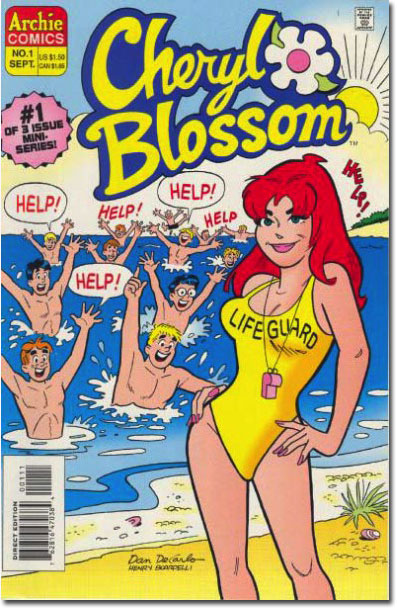
Cheryl Blossom: Lifeguard.
My life bears no resemblance to two thirds of the plot lines in the typical Archie comic book.  In New Orleans, though surrounded by water, there is no beach.  The few people who swim off the batture... the current carries them away forever.  There are no lifeguards in New Orleans.  There is no drama.

Sunday, January 08, 2012

New Orleans dreams

New Orleans in a shot glass.
They say Hollywood is a dream factory.  I see why.  For different reasons, in very different ways, I think New Orleans, Louisiana is a dream factory.  Living here, day after delightful day, I feel untethered from the reality that rules every other place I've lived.

I spent some years in Naples, Italy, an outsider speaking only English, in a city with more than a million inhabitants, that has only one McDonald's and two Chinese restaurants (when I lived there, least).  Different rules applied to life in Naples.  Different rules apply in New Orleans.  It is a world like none other.  The rest of the world is out there, it just doesn't matter very much.  A living city is a microcosm.

When I hear a trumpet player keeping himself company along his, or her, long midnight walk home, I hear the heartbeat of a living city.  It sings.

I spent a few years in Boston.  That city calculates and studies.  I've lived in Queens, a part of a city that schemes to make a buck.  I've lived in Newport, Rhode Island, a place apart, that stuns with its beauty.  I've was nurtured and came of age in New London, Connecticut, a place where no one visits, unless they mean it.  I've lived in Chicago, and there was nothing wrong with that, except the weather.  I've lived in Houston, and I never want to go back.

I live in New Orleans, now.  I never want to live anywhere else again.

I live, alive, in New Orleans, without a care in the world.  New Orleans incubates dreams.  It fledges dreamers when they are ready to soar between Riverbend and Hollygrove, between Bayou Sauvage and the slippery shores of the mighty Mississippi River.  If an idea has legs, it will be able to swim.  New Orleans is a dream factory filled with small entrepreneurs looking to mint something more than coin.  It a city in which dreams come true.

Saturday, January 07, 2012

Another day in New Orleans

Is it right or is it wrong?  It is too close to call.  While I often go about my daily routine to the tune of Yaketty-Sax, I can't say that this song is appropriate for all occasions, except when it is.

A day in the life of Whalehead King.  Balaenius Rex!, 

Wednesday, May 05, 2010

Boycotting BP


I just did the math.  Since leaving Boston, Massachusetts and arriving in Fort Payne, Alabama I've travelled 1463 miles over four days and fifteen pit stops.  None of those miles were powered by a single drop of BP gasoline.

Again, a tip of the fedora to the New Orleans Ladder for this image.

Saturday, May 01, 2010

Saddling the steel pony

My last day at work was yesterday.  I hit the open road tomorrow, traveling from Dorchester to New Orleans on a 2006 Ninja 250R.  Mine's blue.  The saddlebags are packed with whatever I can think of.  Changes of clothes, including a suit, are on the starboard side.  Supplies and blankets at port.  I'm sure I've forgotten something important but it will be too late by the time I realize I need it.  It will be an adventure.
This is the Little Ninja 2 years ago. Note the Sox.

I've had a sticker of a Massachusetts flag on the port side of the Ninja's body for almost three years.  I peeled it off today the same way I removed the faded Red Sox sticker a few months ago.  My helmet had one of those European-style DOT stickers from College Hype in Adams Village (your source for all Dorchester related merchandise).  That came off too.  I replaced that sticker with a UN flag.  I'm traveling across states as a man without a country, a peacekeeper.

I'll be back in Dorchester towards the end of the month.  Starting tomorrow, I'll be describing my motorcycle journey.  I'm going to try avoiding the highways once I hit Pennsylvania...I'm avoiding New Jersey.  As much as I like the rest areas I don't enjoy the New Jersey Turnpike much.  My ETA in New Orleans is May 10; plenty of time to soak up the sights of this great country.

I've dreamed about a trip like this for years.  The day will arrive tomorrow.

Thursday, April 29, 2010

Wearing a motorcycle helmet


I've been a little lax on posting recently because I'm occupied packing my saddlebags and poring over maps for the BABE run that starts on Sunday.  Taking a motorcycle from Boston through New York City to New Orleans should be an easy, if long, affair.  Interestingly, Connecticut and Pennsylvania are the only states on the route that don't require use of a helmet.  These are two states that I won't be spending much time in if I stay on course.

I'm from Connecticut and until I moved to Massachusetts, I didn't wear a helmet.  Never liked them.  I still don't like them but I've gotten used to wearing a helmet.  In fact, I'm so used to it that I wouldn't consider taking it off to feel the cool breeze in my hair.

I have both a full face helmet and two visor helmets (five button).  I'll be taking the full face down to the Big Easy.  I'll be wearing the padded jacket and thick pants with armor over the knees.  I'll be wearing the touring boots from Aerostitch that cost so much I can't bear to get rid of them though I rarely wear them.  It's for a ride like this into terra incognita that you need combat touring boots.

So with all the cartographic study and essential packing, I haven't been singing Dorchester's praises.  I am distracted.  I intend to be posting while I'm on the trip though:  A Dorchestarian on the road, as it were.  Once I arrive in the Crescent City, I'll resume my normal schedule of near daily missives to the ether.  I'll be back in Dot at the end of May for a brief stay and then its another cannonball run, that time via UHaul.

Tuesday, April 27, 2010

Another city's Universal Hub

New Orleans doesn't have a Universal Hub or Crescent Hub or Easy Hub or whatever it might be called.  The Big Easy's version that isn't quite as interactive but it's served as one of my online gateways to the Crescent City.  New Orleans Ladder is what it's called, a daily tier of links that people will find of interest about New Orleans.

The daily updates are usually without editorial commentary.  The links in the sidebar are an exhaustive trove of New Orleans' blogs and viewpoints.

My favorite entry from today is The Man Who Knew Too Much.  Evidence of Katrina isn't hard to find in New Orleans and though the city retains it's vitality, the scars and the memories remain fresh.

"A screaming comes across the sky.  It has happened before, but there is nothing to compare it to now."  Gravity's Rainbow, Thomas Pynchon.

Sunday, April 18, 2010

New Orleans soundtrack

I sit on my Dorchester, Mass. porch with the weather alternating between partly cloudy and drizzle.  As I go about my Sunday routine my mind is elsewhere.  I'm listening to WWOZ, the soundtrack of New Orleans.  I've been listening to the station for a few weeks off and on and I've never been stuck in a dull stretch.

It helps if you like music.  I'm no expert but I don't listen to any Boston stations beyond NPR.  Nothing has caught my ear in the almost three years I've spent on the Boston radio dial.  Is there a Dorchester station beyond the UMASS one?  WUMB, 91.0, does boast providing authentic music for our time.  I don't think folk music is particularly indigenous or relevant to Dorchester or Boston as a whole at this point in time. moment.  I may be wrong.  I admit I haven't looked very hard but whenever I hear folk music in Dot, it's Celtic.

If you want to support your local, Dorchester college station, check out WUMB.  If you want to hear some good stomping and swaying music, check out WWOZ.  Some people dream of the green shores of Ireland when they are in Dorchester.  I dream of New Orleans.

Tuesday, April 06, 2010

Nola mayor-elect in Boston


The mayor-elect of New Orleans is in Boston today, spending time in Cambridge and then having a little tete-a-tete with everyone's favorite urban mechanic.  What pearls of wisdom will Boston's longest serving incumbent have to impart to the new guy?


I don't know too much about New Orleans politics at the moment, but Mayor-Elect Landrieu has convened several citizen advisory panels to help him set policy as soon as he takes office next month.  It seems Mayor Nagin wasn't very popular and didn't make many popular decisions.  He beat Landrieu in a close race in the previous election and people have been rueing that turn out in the interim.   Of note, Landrieu has served as Lt. Governor of Louisiana in the past.  That's a nice bit of experience for a city's top official to have.

If you read the Times-Picayune article on Mitch Landrieu's visit to our fair city, you'll see he has unspecified business in town through Wednesday.  I don't think he'll be coming to Savin Hill to congratulate a soon-to-be future immigrant on his wise decision but I do have a piece of advice:

Mayor-Elect Landrieu, before you head back to the beautiful. lively city of New Orleans, you may want to see the most beautiful and lively part of Boston.  Since you are going to be here tomorrow morning head up to Dorchester Heights and stand in the park at sunrise.  Face south and as the rosy sky breaks to gold and cerulean you will see Dorchester stretched out before you in all its majestic glory.  That will give you something to think about when you are considering plans to rebuild the Lower Ninth Ward and New Orleans East.  You could do far, far worse than match Dorchester's vitality.

I'm sure I'm going to love the Big Easy, but I'm going to miss Dot.

Another piece of advice:  If you want to do anything after midnight, there aren't many options but you can always go bowling.

Monday, April 05, 2010

AA BABE


This isn't about hotties who are recovering alcoholics.  This is about a motorcycle run that starts in the Athens of America and heads through the Big Apple, ending in the Big Easy.  Boston to New York to New Orleans.

I'm going to attempt it in May and I'm poring over maps and planning how to pack my saddle bags.  My Little Ninja had some electrical problems recently and I brought it to the shop.  I told Bob that I wanted the battery ship shape because of what I was planning.  "Are you hoping to find yourself?" he asked.  I replied that I think I have already found myself but I have to get the bike to the Big Easy somehow and driving it seemed the most straightforward way.

Why does my motorcycle need to be in New Orleans?  Because that is the city I intend to call home.   Boston is okay but I like to stay out late.  Dorchester has been the best part of Boston, but like the city at large, Dorchester loves its beauty sleep.  The living is easy in Dot but the whales are jumping in New Orleans.  At least one will.

Tuesday, March 23, 2010

Is Gillette ripping Boston off?

Everyone says the cost of living is cheaper in the South and I thought I'd test that theory.  As everyone knows, Gillette's World Shaving Headquarters is located right at the base of South Boston.  You may not know this, but I live about a mile and a half from there in a straight line down Dot Ave.  Maybe it's two miles.  If I stop for traffic lights, it's five minutes by bicycle.

I went to the Rite Aid drug store on the corner of Savin Hill and Dorchester Avenues to price an eight-pack of Mach 3 razor blades.  As of March 13th the list price was $21.99.  Some people may think that's a bit steep, but Mach 3 employs the latest shaving technology, if you don't mind using the words 'shaving' and 'technology' in the same sentence.

I travelled 1360 miles as the airline flies to New Orleans to check up on the price of an eight-pack of Mach 3s there, among other things.  I went to a Rite Aid on Canal Street, on the corner of North Broad Street, store # 7262, on March 18th.  This is in Mid-City, a neighborhood reminiscent of Dorchester in New Orleanian terms.  The price of an eight-pack of Mach 3 blades there: $18.99.  A three dollar savings.

Does it really cost less to ship razor blades 1360 miles than it does couple of blocks?

So is Gillette ripping off Bostonians?  I don't know.  Maybe Rite Aid is ripping off Bostonians.  For all I know Massachusetts has some arcane shaving tax in effect.  I'll tell you this though, if you plan a few days ahead, you'll still get them cheaper at Amazon.  They'll only cost you $17.97 and will probably qualify for free shipping.  That's the price for Mach 3 Turbo, if you don't mind using the word 'turbo' in connection with shaving.

Saturday, March 20, 2010

Charity Hospital


Charity Hospital was the New Orleans equivalent of Boston Medical Center.   It was closed after Hurricane Katrina and it isn't scheduled to be reopened.  Imagine if BMC were erased from Boston's health care network.


I took the Canal Street street car to the cemeteries this morning.  The Canal Street line splits at Carrolton Avenue, half the cars go to City Park and the art museum, the other half go to the above ground necropolises at the far side of town.  I stopped into the Charity Hospital Cemetery which was founded in 1848 as a potter's field.  There aren't any marked graves in this cemetery.

There is, however, a memorial that is the final resting place for the unidentified and unclaimed remains of those who perished during Katrina.  There are six mausoleums, unmarked with black granite facades arranged in a pattern that mirrors the shape of the storm.

The commemorative narrative inscribed on a block of granite concludes, "Let their souls join in an eternal chorus, singing with the full might of the indomitable spirit of New Orleans."

Life goes on in New Orleans.  Though many neighborhoods still bear scars from the brunt of the flood, life goes on as normal.  New Orleans is both a queen among American cities and a dowager.  She has seen better days and worse ones too.  Better days are ahead of today that will outweigh the worse ones that will inevitably accompany them.

The French Quarter is the vibrant heart of this regal city and that is what the tourists pay to see.  New Orleans is a skein of many threads though.  It is a body with many arteries and resilient plexuses.  The people who live here haven't given up hope or human kindness.  They haven't given up on charity.

Friday, March 19, 2010

The City Care Forgot

While the moniker "The City that Care Forgot" doesn't really apply to the Big Easy post-Katrina, the atmosphere is very different in New Orleans than it is in Boston, and I don't mean the humidity.  I'm in my third day here and I am naturally living a tourist's life rather than a citizen's but the congeniality is impressive.

I won't say that I find Boston oppressive, weather aside.  I mean that there is an easygoingness in New Orleans that Boston lacks.  I've been here before so I'm not entirely blinkered by the hospitality and I know it's not all pralines on the levee.  The decay on display is not just genteel, some of it is depressingly real.  Despite that, there is joy in the ruins and plenty to savor.

I'm staying in the French Quarter because I got a good hotel deal.  Last night, I walked Bourbon Street taking in the music, popping into one club after another.  No cover charge, the music spills into the streets.  There were some awful cover bands but there was some inspired, traditional jazz.  People were  gathered outside Preservation Hall for a reason.  The trumpeter melded so many triumphal marches into his solo of "When the Saints Go Marchin' In" including the Star Wars theme that people swooned long after the clarinetist took over.

I checked my watch, my internal Boston-based clock was ticking.  The MBTA shuts down at 12:30 and sure enough the clock on my wrist read midnight.  I am used to leaving according to the MBTA schedule; it's ingrained.  No worries though, on Bourbon Street, midnight is the midpoint toward when the night ends.

If I were taking public transportation, I needn't have worried much.  I was on the Canal Street line and a woman asked when the last street car would run.  "2:30 in the morning, ma'am," the driver answered.  Checking the RTA schedule, the first outbound car of the day runs at 4:22 AM.  If I were headed homeways on the St. Charles Line, the last train from downtown would be at 3:07AM with service resuming slightly an hour later.

That's a city that relishes its good times more than its beauty sleep.  

Oh, and the highlight of last night's musical adventure: listening to a nine-piece band blast out a funkadelic version of "Car Wash."  Those horns wailed.

Thursday, March 18, 2010

Streetcar Sue

The St. Charles Avenue streetcar line runs from downtown to Carrolton.  The cars were built in 1926, two decades before the Mattapan High Speed cars but basically of the same design.  If you don't have a need to travel to Mattapan via the MBTA, the museum pieces on display at Boylston will give you an idea.  The cars on Boston's Green Line are updated versions.

Should you take the St. Charles to the end, you'll see they don't turn around.  Rather, the driver gets out of the car and lowers the device in back that connects the car to the overhead wires.  Then, the driver goes to the front of the car, now to be the back, and released an identical device overhead.  The front becomes the back.  There are controls at either end of the car to accommodate this change from back to front and vice versa.  In fact, the rear of the car, with its controls and driver's seat is often occupied by passengers during crowded runs.

I had the pleasure of riding the St. Charles line twice today run by the operator with the badge number 626.  This is a woman who enjoys her job.  She welcomes passengers and gives them advice and history about the neighborhoods through which her car passes.  "All aboard who's coming aboard!" she says at stops.  "Get ready for takeoff!" she warns when she's about to resume movement (the street cars rarely exceed 5mph).

She is used to tourists.  Natives take the streetcar, but the St. Charles Line goes through some of the most beautiful neighborhoods in New Orleans, across the top of the Garden District, past Loyola and Tulane universities, and Audobon Park, as well as into Carrolton.  "Go spend a lot of money and leave a big tip.  If you do, tell 'em Streetcar Sue sent you!" Operator 626 admonishes.  "If you don't, don't tell 'em I sent you," she adds with a laugh.

Some MBTA drivers have a personality. I've encountered a few on the E Line.  Once in a blue moon a Red Line driver will wish passengers a nice day.  Mostly though, MBTA employees on the trains seem to be a sullen lot.  Not all the drivers on the St. Charles Line are mass transit ambassadors either, but they have more direct interaction with the public.  There aren't many passes in use.  The fare is $1.25 and the drivers are forever finessing dog-eared dollar bills into the fare machines.  I have yet to meet a truly disgruntled RTA employee.  They can be harried, but they remain human.

A tip of the fedora to Streetcar Sue, an inspiration to mass transit workers everywhere who see their jobs as professions rather than chores.  A ride on the St. Charles Streetcar is a joy and it more so when Operator 626 is at the helm.

LinkWithin

Related Posts with Thumbnails